Wine Australia Export Report 2026
Key takeaways from Wine Australia’s Export Report 2026
Wine Australia Export Report — year ended June 2026
Wine Australia’s Export Report for the year ended June 2026 is out, and beyond the headline numbers, a few things stood out to us.
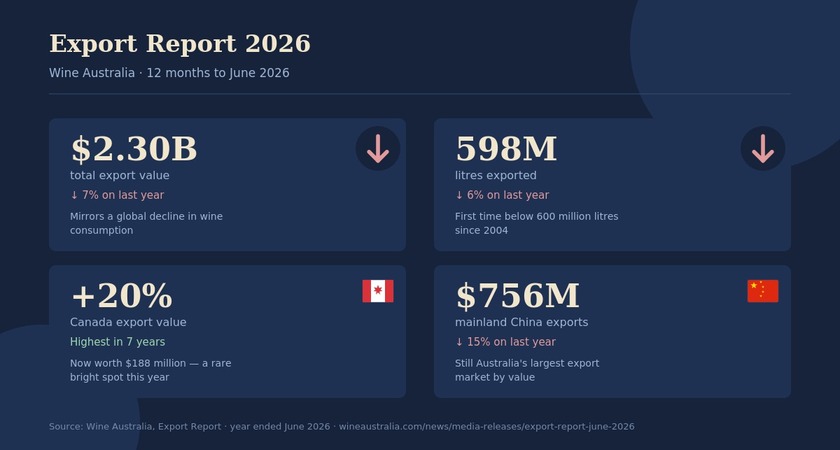
Export value is down 7% to $2.30 billion and volume is down 6% to 598 million litres — the lowest volume since 2004. The headline is a milestone, but the real story is why. This isn’t a one-off bad year — it’s part of a longer-running trend: global wine consumption has fallen to its lowest level since 1961, as drinkers moderate alcohol intake, watch costs, and reach for alternatives.
The pressure is concentrated in Australia’s three biggest markets, but it isn’t hitting them the same way. Mainland China remains the largest by value, down 15% to $756 million as the post-tariff restocking bump fades — a settling into a smaller, slower-growing baseline rather than a fresh downturn. The UK and US both fell to their lowest shipment levels in 25 years, yet the impact looks different in each: UK weakness is concentrated in commercial and mid-priced wine, with premium sales holding up, while in the US the softness is broader and cuts across most price tiers — a sign the US problem runs deeper than discounting pressure alone with tariffs most likely the reason.
Canada was the standout — export value up 20% to $188 million, its highest in seven years, with volume up 13% too. Wine Australia itself links this to the Canada–US trade dispute, as reduced availability of US wine presented an opening for Australian brands. That benefit is a ‘one-off’ but also an opportunity to capitalise as consumers get a greater exposure to Australian wine.
The more durable growth story may be in Asia outside mainland China. Singapore overtook the rest of the region to become Australia’s largest Asian market outside China, and Thailand posted record export values on the back of rising premium demand — alongside gains in Malaysia, Japan, South Korea and Taiwan. Unlike Canada’s tariff-driven bump, this looks more like organic, premium-led demand building in markets with less exposure to the US-China dynamics reshaping the rest of the export book.
The takeaway: this isn’t just a smaller export base, it’s a differently shaped one. The old reliance on a handful of mature, high-volume markets is giving way to a mix where premium positioning and genuine market diversification — not just opportunistic gains from someone else’s trade dispute — look like the more reliable paths through the reset.
Source: Wine Australia, Export Report — year ended June 2026