Wine Australia National Vintage Report 2026
The 2026 vintage: correction, or over-correction?
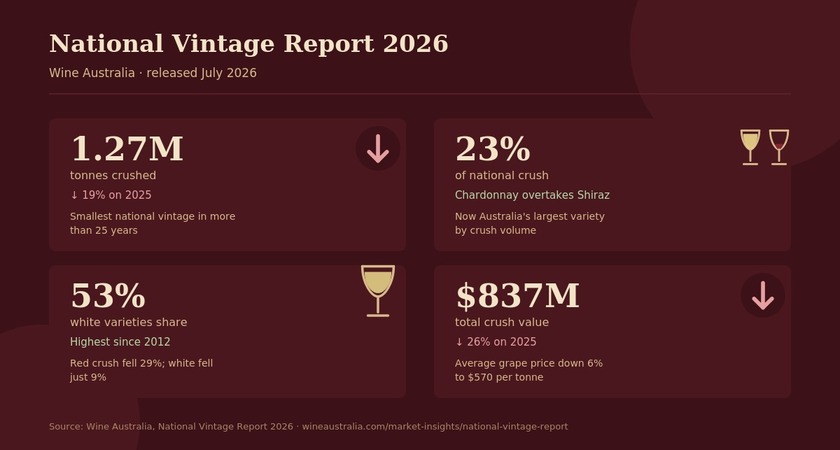
Wine Australia’s National Vintage Report 2026 records a national crush of 1.27 million tonnes, down 19% on 2025 — the smallest vintage in over 25 years. Red varieties bore the brunt, falling 29%, while white varieties declined just 9%.
Wine Australia’s own explanation is that this reflects a deliberate industry response to weaker demand rather than a bad season alone. Market Insights Manager Peter Bailey has attributed the lower crush primarily to producers adjusting output to match a smaller, more white-leaning market.
That explanation holds up in the numbers. Chardonnay is now Australia’s largest variety by crush volume, overtaking Shiraz for the second time in three years and lifting its share of the national crush to 23%. White varieties overall now account for 53% of the crush, their highest share since 2012 — production is visibly shifting toward where demand sits.
But there’s a question the report raises without fully answering. Bailey himself has flagged a risk of over-correction, noting that the industry still lacks reliable data on vineyard plantings and removals and won’t have a clear picture until the National Vineyard Register is complete. In other words, Wine Australia doesn’t yet know how much vineyard capacity has actually left the system, or whether growers are pulling red and white vines in sensible proportions.
That matters because the dynamic behind years of red oversupply could just as easily overshoot in the other direction. A 25-year-low harvest, driven by thousands of uncoordinated individual decisions, is not a precise instrument. If enough growers exit at once — particularly in the warm inland regions already absorbing the steepest cuts — the industry could find itself short of supply, including premium and white fruit, just as consumption patterns stabilise.
The 2026 vintage is best read as an industry mid-correction, not one that has necessarily found its new equilibrium. Whether it settles at a sustainable, smaller scale — or swings past it — will depend on data the industry doesn’t yet have, and decisions that growers and winemakers haven’t made yet.